Showing posts with label cook the books club. Show all posts

Friday, December 3, 2010

cook the books club - heat


Our current reading assignment for Cook the Books is  Heat {An Amateur's Adventures as Kitchen Slave, Line Cook, Pasta-Maker, and Apprentice to a Dante-Quoting Butcher in Tuscany}, by Bill Buford.

I thoroughly enjoyed Mr. Buford's telling of his experiences in various professional kitchens, particularly the tales of Mario Batali's kitchen in his three-star restaurant, Babbo.  Based on my limited professional kitchen experience, I found his account to be entirely believable. Although most of my restaurant experience has been from the other side of the heat lamp as a server, I have witnessed first hand the ginormous egos that take up most of the room in these kitchens already lacking in space.

About twelve years ago, I had the opportunity to work in the kitchen of a restaurant.  Friends of mine owned a small bistro that served a variety of foods, including steaks and gourmet burgers along with a few Greek specialties.  I was between careers, at another "what am I going to do now?" interval in my life.  They were short a cook and knowing first hand my abilities and my passion for food as we had shared many meals together, he asked me if I wanted to cook with him at the restaurant.  Before I said yes, I considered the effect this might have on our friendship because we were very close friends and I didn't want to jeopardize this.  My curiosity or my thirst for a challenge got the better of me and against my better judgment, I decided to give it a go.  Before I go any further, I have to explain something here.  He is Greek, as Greek as they come.  Not that there is anything wrong with that but if you can imagine the healthy ego of a European man combined with the ginormous ego of a chef, you will understand why there was no room for me in that kitchen.  I squeezed in anyways and had a little fun in the process before I decided I could no longer breathe.  When I told him that I didn't think that the restaurant kitchen was for me, he said, "If you can't stand the heat, get out of the kitchen!"  We laughed about that for a long time.  I am glad that I left before it was too late to laugh.

Near the end of the book, Mr. Buford comes to a realization.

"Alarmingly, we then left to get something to drink (Mario was parched), when he put the question to me again: so, a restaurant?  And I realized: no.  I did not want a restaurant.  When I started, I hadn't wanted a restaurant.  What I wanted was the know-how of people who ran restaurants.  I didn't want to be a chef: just a cook."

As I read this, I found myself nodding.  That was me: just a cook.

Throughout the book it is said over and over again that a good pasta dish is about the pasta, not the sauce.  So I decided I would make fresh pasta for the first time and then at Mr. Batali's suggestion, top it off with just a basic tomato sauce in order to let the pasta take center stage.


Mario Batali's Basic Tomato Sauce

Ingredients

  • 1/4 cup extra-virgin olive oil
  • 1 Spanish onion, 1/4-inch dice
  • 4 garlic cloves, peeled and thinly sliced
  • 3 tablespoons chopped fresh thyme leaves, or 1 tablespoon dried
  • 1/2 medium carrot, finely grated
  • 2 (28-ounce) cans peeled whole tomatoes, crushed by hand
  • Salt
  • Spaghetti, cooked al dente
  • Whole basil leaves, for garnish
  • Grated Parmesan, (optional)

Directions

In a 3-quart saucepan, heat the olive oil over medium heat. Add the onion and garlic, and cook until soft and light golden brown, about 8 to 10 minutes. Add the thyme and carrot, and cook 5 minutes more, until the carrot is quite soft. Add the tomatoes and juice and bring to a boil, stirring often. Lower the heat and simmer for 30 minutes until as thick as hot cereal. Season with salt and serve. This sauce holds 1 week in the refrigerator or up to 6 months in the freezer.

When ready to use, the cooked pasta should be added to a saucepan with the appropriate
amount of sauce. Garnish with basil leaves and cheese, if using.


Note: I used a fresh pasta recipe from Giada de Laurentiis and the recipe will follow in a later post.

This is my submission to "Cook the Books" which is hosted by Rachel of the Crispy Cook, Deb of Kahakai Kitchen and Jo of Food Junkie, not Junk Food.

Saturday, September 25, 2010

cook the books club - climbing the mango trees


Our current reading selection for Cook the Books Club is Climbing the Mango Trees - A Memoir of a Childhood in India, by Madhur Jaffrey.   If you are looking for a book that provides insight into Indian food and culture with a little history lesson thrown in, then you will find it here.  If you are looking for a memoir that reads like a novel complete with plot and character development, this is not it.  

Certainly, there were moments of intrigue and whimsy. Such was the story of the Lady in White who made a frothy ambrosial drink from dried seafoam and dew.
"It was, indeed, the most ephemeral of fairy dishes, a frothy evanescence that disappeared as soon as it touched the tongue, a winter specialty requiring dew as an ingredient.  Whenever I asked the Lady in White how it was made, she would sigh a mysterious sigh and say, "Oh, child, I am one of the few women left in the whole city of Dehli who can make this.  I am so old and it is such hard work.  What shall I tell you?"
This book is filled with cooking methods and recipes but does not go much further than that, which is fine because she does this well. I loved the descriptions of school lunches with her friends when they all unpacked their tiffin-carriers and she compared the different foods that they had brought.  Their various religions played a dominant role in those differences.

"Sudha's food was as Jain as Abida and Zahida's was Muslim.  It was completely vegetarian, devoid of onion and garlic, as those bulbs were thought to arouse base passions; devoid of tomatoes and beets, as their color was reminiscent of blood; and contained no real root vegetables, as pulling out roots killed the entire plant."
I find it quite ironic that Madhur Jaffrey has made such a success out of cooking and did not learn to cook until she had left home.  Her mother taught her to cook by "air mail" when she found herself longing for the tastes of home and had no kitchen or servants to order her food from.  She had to do it herself if she wanted to eat in the manner which she was accustomed.

I tried to order some food from my "kitchen" but nobody listened so I had to do it myself.  First of all, I had to do the shopping because I couldn't find any servant to do it for me.   As I enter the Indian grocery store, the sounds of a loud Indian voice ululating from the radio greets me, the rich, exotic aroma of Indian cooking fills the air and of course there are posters of Bollywood movie stars on the walls . It was like being transported, just for a moment, to another country.  I had been there before but this time I noted my surroundings, carefully.  As always, I walked in with a list in my hand and was immediately asked if I needed any help.  Do you think I looked out of place?  Probably.  Here comes the white girl thinking she can cook like an Indian woman.  I am sure they snickered behind their hands.  Well, I showed them as I walked out of there with my spices and my twenty pound bag of Chapati flour.  "How may Rotis do you think I will get from this bag of flour," I jokingly asked.  "Oh, you have no idea," she said.  She was right, I had no clue but I was ready for some serious roti making.

I gathered all the ingredients on my counter.  It made a colourful display reminiscent of a foreign marketplace so I had to take a picture.


Then I ordered some Rotis from the kitchen.  The recipe for this flat bread is pretty basic.  I used 3 cups of Chapati flour, about 1 1/4 cups of water and about 3 tablespoons olive oil.  Mix all of these ingredients together to create a dough. Knead for about seven minutes and then let the dough rest for about 2 hours.  Separate the dough into balls and roll each ball out into a fairly thin circle using more Chapati flour for dusting. 


I cooked the Rotis over medium heat on a round cast-iron pan called a tawa.  When the colour changes and bubbles appear, turn it over.  Spread butter or ghee over the cooked side.


Serve warm.


With Cucumber Raita.  Mix 1 cup of plain, thick yogurt with 1/2 cup drained, chopped cucumber, 1 1/2 teaspoon cumin and 5 tablespoons chopped cilantro.  This yogurt mixture serves to cut the heat of the spicy Indian foods and it is really quite delicious with Rotis.


The next dish that I ordered from the kitchen was this one.


Madhur Jaffrey's Basmati rice with dill and cardamom. 
Serves 6 or more

Use a gentle folding action to stir the rice for this delicious pilaf, since it is very delicate and, as Jaffrey pithily points out, "You have paid for whole grains, not broken bits."
The quantities are generous, but leftovers are good cold as a basis for a rice salad with chopped tomatoes and fresh coriander.

A 16floz/500ml measure of basmati rice
3 tbsp olive oil
One 3 inch/8cm cinnamon stick
5 whole cardamom pods
2 bay leaves
Half a small onion (about 2½oz/85g), sliced into fine rings
Small bunch dill, chopped
22floz/650ml chicken stock (Waitrose Cooks Ingredients stock is a good ready-made option)

Put the rice in a bowl and pour over enough water to cover. Swill the rice around with your hands, then drain through a sieve. Repeat several times, until the water is clear not cloudy.Drain, then add fresh water to cover generously and leave to soak for 30 minutes before draining again.

Pour the oil into a heavy pan, one which has a tight-fitting lid and will just fit the cooked rice. Set on a medium heat and when the oil is hot add the cinnamon stick, cardamom and bay leaves.

Stir for five seconds, then put in the onion. Cook, stirring, until the onion turns reddish brown.

Add the rice and dill. Reduce the heat to medium-low and stir until the rice grains look translucent (about two minutes). Add the stock, plus about 1 tsp salt if the stock is unsalted, and bring to the boil.

Cover tightly. Reduce the heat to very low and cook for 25 minutes.
Keep covered in the pan until you are ready to eat.


Then from the kitchen, I ordered:

Madhur Jaffrey's South indian-style stir-fried green beans
Serves 4-6
In India a kind of lentil called urad dal is used to add crunch and a nutty flavour, but peanuts also work well. Asafoetida is a resin with a pungent smell which softens on cooking to a musky scent Jaffrey describes as "truffle-like". It's excellent with beans and vegetables.
12oz/340g French beans cut into 1inch/2.5cm pieces
1 tbsp peanuts (not roasted)
1 tbsp olive oil
¹/3 tsp ground asafoetida
1 tsp whole mustard seeds
2 dried hot red chillies
8-10 fresh curry leaves (optional)
¼-½ tsp cayenne pepper
Half a lemon (optional)

Bring a large pan of water (about 3½ pints/2.2L) to the boil, add 1 tbsp salt and the beans. Boil hard for four minutes until the beans are cooked through.  Drain and cool under a cold tap. Meanwhile, crush the peanuts in a pestle and mortar into peppercorn-sized pieces.  Pour the oil into a frying pan or wok and set over a medium-high heat. When the oil is hot, add the asafoetida, mustard seeds, peanuts and whole dried chillies. As soon as the mustard seeds pop, tip in the drained beans and the curry leaves, if using.  Turn off the heat. Toss well, add the cayenne and season with salt.Heat up over a gentle heat and serve, squeezing over a little lemon juice at the last minute if you like. 
From an article published at Telegraph.co.uk


The dishes kept pouring from the kitchen.

  
Madhur Jaffrey's Chickpeas cooked in tea - Dhabay Kay Chanay 

"Cooked in tea? You might well ask! This is the trick that all the vendors at truck stops use to give their chickpeas a traditional dark appearance. The tea –leftover tea may be used here – leaves no aftertaste. It just alters the colour of the chick peas.For speed, I have used canned chickpeas. As they are already cooked, they need just 10 minutes of gentle simmering to absorb the flavourings. I have also used canned chopped tomatoes. If you wish to substitute fresh, chop them very finely and use 1/2 cup instead of 1/4 cup.This chickpea dish may be served with store-bought pita bread, a yogurt relish, and some pickles or salad. It could also be served as a snack or as part of a more elaborate meal with meat or chicken, a green vegetable, and rice."

Serves 4 to 5
2 cans (19 oz each) chickpeas (garbanzo beans)
¼ cup vegetable oil
generous pinch ground asafetida, optional
1 tsp cumin seeds
1 medium-small onion (6 oz), peeled and chopped
3 cloves garlic, peeled and finely chopped
¼ cup canned chopped tomatoes
2 tsp peeled, finely grated ginger
1¼ cups prepared tea (use a plain black tea; water may
be substituted)
1-2 fresh, hot green chilies, cut into very fine rounds (do
not remove seeds)
1 tsp salt
2 tsp ground toasted cumin seeds
1 tsp store-bought garam masala
3-4 Tbsp coarsely chopped fresh cilantro
1 Tbsp fresh lemon juice

Drain the chickpeas. Rinse them gently with fresh water. Drain again. Put the oil in a wide pan and set over medium high heat. When the oil is hot, put in the asafetida. Let it sizzle for a second. Now put in the cumin seed sand let them sizzle for about 15 seconds. Put in the onion. Stir and fry until the onion turns quite brown
at the edges. Put in the garlic and let it turn golden, stirring as this happens. Now put in the tomatoes.
Stir and cook them until they turn dark and thick.Add the ginger and give a few good stirs. Now put
in the chickpeas and all the remaining ingredients.Bring to a simmer. Turn the heat to low and simmer,
uncovered, for about 10 minutes, stirring gently now and then. Taste for balance of flavours and make
necessary adjustments.
From Madhur Jaffrey’s Quick & Easy Indian Cooking
© 2007 Chronicle Books

 
Madhur Jaffrey's Salmon with mustard seed and coriander
For marinating the fish:
2lb/900g skinless salmon fillet (ideally cut from the thicker end of the fillet)
¹/3 tsp cayenne pepper
¹/3 tsp ground turmeric

For the sauce:
3 tsp whole brown mustard seeds
1½ tbsp ground coriander
1 tsp ground cumin
¼ tsp ground turmeric
1 tsp curry powder (Jaffrey uses Bolst's hot curry powder, available from www.indianfoodandspices.co.uk, but any curry powder will do)
½ tsp cayenne pepper
6oz/180g tomatoes, coarsely grated (messy, but possible – the skins will be left in your hand)
3 tbsp extra virgin olive oil
½ tsp whole fennel seeds
15-20 fresh curry leaves or 6 bay leaves or fresh coriander

Cut the salmon into matchbox-sized pieces.
Mix the cayenne and turmeric with ¹/3 tsp salt and rub the mixture into both sides of the fish. Put in a plastic bag or a covered dish and refrigerate for at least one, and up to six, hours.
Now make the sauce. In a clean coffee grinder or mini food processor, grind 2½ tsp of the mustard seeds. (You could also do this with a pestle and mortar and lots of elbow grease, or even use mustard powder.) Put the ground mustard in a bowl with the coriander, cumin, turmeric, curry powder, cayenne, tomatoes, ¾ tsp salt and 4floz/110ml water. Mix well.
Heat the oil in a wide, shallow pan (a deepish frying pan or sauté pan is ideal) over a medium-high heat. Add the remaining mustard seeds and as soon as they begin to pop add the fennel seeds. Stir and pour in the spice mixture and another 8floz/225ml water.
Add the curry leaves, if you have them, or bay leaves. Bring to a simmer and cook gently for 10 minutes. (At this point the sauce can be cooled and refrigerated for several hours.)
To cook the fish, reheat the sauce (in the wide, shallow pan again) and lay the fish in it. It's important the fish cooks in a single layer, so if you are doubling the quantities, use two pans.
Simmer for five minutes, then carefully turn the fish and cook for another 4-5 minutes until just about done.
Scatter with coriander (if you aren't using curry or bay leaves) and serve with rice or naan.

From an article published at Telegraph.co.uk


Photo credits go to my good friend, Karen Dyck, who was happy to have her first paid photo gig.  I paid her in food.  It was a win/win, I think.


Wednesday, July 28, 2010

cook the books club - the school of essential ingredients

Recently, in my ever consuming perusal of food blogs, I came upon this online Cooking/Book Club called, "Cook the Books".  I loved the idea of combining two of my greatest passions, cooking and reading, and without hesitation, I declared myself in.  GWH just shook his head at me in exactly the same way that I would shake mine at him if I were crazy enough to be up at three o'clock in the morning when he went fishing.

"Cooking the Books" is hosted by Rachel of the Crispy Cook, Deb of Kahakai Kitchen and Jo of Food Junkie, not Junk Food.  The premise of the club is to read the chosen book, to cook something inspired by the book and then to write a review and post your recipe on your blog.  The current title is The School of Essential Ingredients, by Erica Bauermeister.


I was trying to decide how to review this book without sounding too much like I was gushing.  As I was trying to put into words how the book made me feel, my mantra of the moment came to mind - write from the heart, right from the heart - and it certainly seemed to me that Erica Bauermeister has done just that in this first novel.

I love the idea that good food is intricately intertwined with our emotions, that it can be healing and that cooking for someone is an act of love.  To me, this book is reminiscent of Like Water for Chocolate, by Laura Esquival, not as fanciful, perhaps, but equally as provocative and charming.

The book is set at a restaurant called Lillian's that becomes The School of Essential Ingredients every Monday night when the restaurant is closed.  The classes are taught by the restaurant's owner, Lillian.  Lillian has the uncanny ability to know just which ingredients are essential to her students although there are no recipes used in her classes.

As I read the book searching for inspiration for that perfect recipe, I changed my mind several times. Each time a new character's story was introduced to me, I decided that I had found my recipe.  There was something about each one that spoke to me; that I could relate to.

The book starts out with Lillian as a little girl.  She instinctively learns to cook to fill the void left by a physically absent father and an emotionally absent mother.  Abuelita, a woman who befriends Lillian and becomes her cooking mentor, says to her, "Sometimes, nina, our greatest gifts grow from what we are not given."  I love that line for so many different reasons.

Claire is the young mother whose life has melted into that of her husband's and her children's so that she, as a singular ingredient, is lost.  "She became the frame for the picture that was her son and daughter"  In the first cooking class, they cook crab; specifically, they kill and dismember the crab.  The author then describes the birth of Claire's first child and that first moment when she realizes that her life will never be the same again. "She kept thinking the waves would slow or break for a moment, but they didn't, one after another until there was nowhere left to go but in, to dive down and hope for air on the other side, but there was no air, no way out, just a desperate reaching and grasping until finally she felt something deep inside her - not physical, not emotional, simply her - break into pieces.  And into the arms of that cracked apart person that had been Claire, they placed a baby and a love came out of her, through the pieces, that she didn't even know was possible." Who would have thought that the description of the crab's demise could be such a beautiful metaphor for childbirth, but it was.

Crab is my favorite seafood and we have caught our own many times.  I didn't even have to read this chapter to know that I was making crab!

Carl is the solid, steady, family guy.  An insurance salesman who has been married to Helen for many years.  "Flour is like the guy in the movie who you don't realize is sexy until the very end.....Butter is so much more alluring.  But the thing is, flour is what holds a cake together."  Helen finds the temptation of "beurre" irresistible and, at forty one, has an affair.  She comes to realize that the "flour" is her essential ingredient and decides to stay in her marriage.  Carl forgives Helen because he just can't imagine a life without her.  Their fortitude is rewarded as they both choose the "white cake" as their dessert in the dinner that is their lives and to all those that watch, their satisfaction of a meal enjoyed is very evident.  "A white cake is the opposite of fireworks and fanfare - it's subtle, the difference in texture between the cake and the frosting as they cross your tongue.  It's a little harder to accomplish...but I have to say, when it works, it is sublime."

Antonia is a kitchen designer who comes from the old country where everything, including cooking and food,  is steeped in tradition and the kitchen is the heart of every home.  She finds herself working on a kitchen with a fireplace that reminds her of her grandmother's kitchen.  This brings to surface a longing for home.  "Antonia had grown up in a stone house lived in by generations of families whose feet had worn dips into its limestone steps, where the smells of cooking had seeped into the walls like a marinade." and "Over the course of the day, the heat from the fireplace would stretch across the kitchen toward the warmth of the stove until the room filled with the smells of wood smoke and meat that had simmered for hours.  Even as a little girl, Antonia knew that when the two sides of the kitchen met, it was time for dinner."  I love the pictures that these words evoke.  When the class makes Pumpkin Ravioli, with hazelnuts and shallots spiced with a little nutmeg, it is like patina on Antonia's tongue and in this dish, she finds a little taste of home and happiness.

This chapter had me looking for a hearty pasta dish with complicated spices where one bite transported you to an exotic old-world country where even the recipes are ancient.  Ah, Tuscany.

Tom's story is a love story; a tragic, beautiful love story.  He falls in love with and marries, Charlie, a vibrant, feisty woman who loves to cook and lives life to the fullest, in and out of the kitchen. After they have enjoyed an amazing, sensuous dinner that she has cooked for them, she says to Tom, "I've met guys who see sex like dessert - the prize you get after you eat all the vegetables that make the women happy.  I guess I see it a little differently....I think sex should be like dinner.  And this is how I like to eat."  Charlie becomes terminally ill with cancer and Tom watches as her life slowly seeps from her body.  "Promise me you'll keep cooking when I'm gone...not just eat, cook."  Fate leads him to Lillian's and it is only there, at the School of Essential Ingredients that Tom begins to learn to truly appreciate the gift that is Charlie's legacy. "They'll eat it, he said, and then it will be gone.  That's what makes it a gift, Lillian replied."

After this chapter, I was so making a sexy red sauce!

Chloe is a young girl in search of the approval that she has never received from anyone - her mother, her father, her co-workers, or her boyfriend.  Lillian gives her a job in the restaurant and allows her to attend the The School of Essential Ingredients.  It is there, as she learns to cook, that she begins to feel safe.  "On a tortilla, with a bit of crumbled white queso fresco, it was both satisfying and invigorating, full of textures and adventures, like childhood held in your hand."  This safe place allows her to gain the approval of the most important, person of all, herself. "That's a good tomato - you don't need to mix it with anything." 

Tortillas, tomatoes, cilantro, peppers... I am always up for a little Mexican food.  Would this be the inspiration for my recipe?

An older woman who struggles to hold on to her memories as they become more and more elusive, Isabelle finds kindness and patience in Lillian and in her fellow students. "Isabelle had always thought of her mind as a garden, a magical place to play as a child...Every year the garden grew larger, the paths longer and more complicated.  Meadows of memories....She had always considered that one of the luxuries of growing older would be the chance to wander through the garden that had grown when she wasn't looking.  She would sit on the bench and let her mind take every path, tend every moment she hadn't paid attention to, appreciate the juxtaposition of one memory against another.  But now that she was older and had time, she found more often than not she was lost..."  Isabelle shows up for cooking class one night only to discover that it is the wrong night.  Lillian graciously seats her in the restaurant and proceeds to serve her a wonderful meal as if it was meant just for her.  The exquisite food sparks her taste buds and her memories and we are taken on a meandering tour of the paths of Isabelle's "garden".  Tom joins her for dessert, at Lillian's prompting, and they each contemplate lost memories.  At which point Lillian says to Tom, "I am starting to think that maybe memories are like this dessert.  I eat it, and it becomes a part of me, whether I remember it later or not."

The idea that memories are brought on by familiar tastes and smells had me in search of my own memory triggers to give me inspiration for my recipe.  Cinnamon, cabbage, oregano, molasses all evoked a certain nostalgia in me.  Hmmm, what would it be?

Ian's mother gives him a gift certificate to The School of Essential Ingredients as a birthday gift.  He remarks to his sister that this is an odd gift coming from a woman who was so preoccupied by her art that she barely had time to cook for them as they were growing up. He soon discovers that she has given him this gift because she recognizes that he could be as passionate about cooking as she is about painting.  "When I paint, it brings me joy.  I wanted you to have that too."  Ian is smitten with Antonia from the moment that he sees her.  Finally he works up the courage to ask her to dinner and for dessert he decides to make her a tiramisu; a dish created in deep contrast to Ian's analytical, logical mind and in tribute to Antonia's creative energy.  "The texture was warm, creamy and soft, like lips parting beneath his own, taste utterly lacking in precision, luxurious and urgent, mysterious and comforting." 

Tiramisu, anyone?  I have made this dish before but this time I would make it better; with a deeper understanding of the complexities.

As I contemplated all the different cooking possibilities that presented themselves throughout the course of this book, I tried to really connect to what my "essential ingredients" were.  On this particular evening that I decided to cook for this review,  I was making dinner for just my husband and I.  I didn't know what it would be until the last minute.  At one point I thought that I would make something that involved a roue paste because I thought it would be symbolic of the fact that I was grateful to have both "flour" and "butter".  The following is the sauce that I made for my husband, GWH.

Red Wine Reduction Sauce

Ingredients
6 sprigs fresh thyme
4 cloves garlic, chopped
1/4 cup green onion tops, chopped
2 tbsp Dijon mustard
1 tbsp beef bouillon powder
2 tbsp olive oil
1 bottle good red wine

Directions
Add thyme, garlic, green onion tops, Dijon mustard, beef bouillon powder and olive oil to a heavy bottomed pot.  Slowly add the bottle of wine and simmer, stirring occasionally, for approximately an hour or until sauce begins to thicken. When it has reached its desired consistency, drain the sauce in a small sieve to remove the  stems.

I served the sauce over a strip loin steak, alongside skewered baby potatoes, peppers and sweet onions.

"...time will change the taste into something smooth - the difference between polyester and velvet."


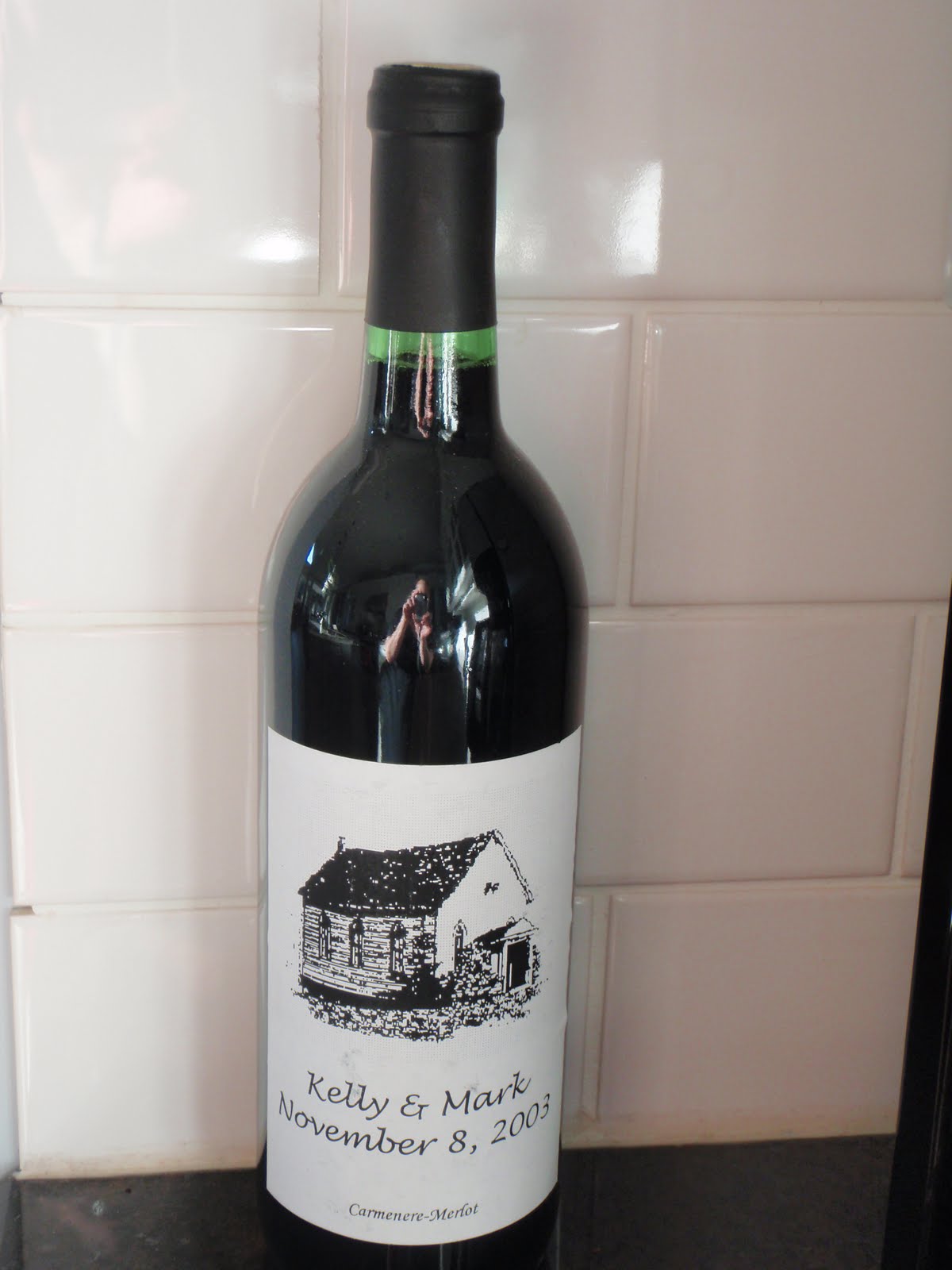
Notes: You always need to bring a little of yourself to the "sauce" so I added a little thyme from my own herb garden which gave it the distinct taste of my  individuality.  The garlic was a nod to the things that we enjoy together and the green onion tops were a compromise as this is the part of the onion that I often throw out, much to the chagrin of my husband.  Without trying them, how would you know if you like them or not?  I have discovered that I really do enjoy them.  The Dijon mustard adds a little bit of mystery (it's french, you know!) that helps the sauce to grow into something a little more complex and the bouillon adds a little salt to balance it.  The wine is a very integral part of the sauce and I chose to use a precious bottle of our wedding wine.  I was counting on the wine to bind the sauce with all the emotions - love, happiness, contentment -  that we felt on our wedding day.  Lastly, make sure that you "drain" all the unwanted, unnecessary, negative components of the sauce so that you are left with all that is good to make a deep, richly satisfying sauce.  So, I know you are wondering, did he like the sauce?  Did he appreciate all that went in to it?   Yes, the results were amazing! ...and the sauce was good too.
Related Posts with Thumbnails